
When people talk about weight loss, the focus is almost always on fat. But beneath the surface, another major change is happening; one that often goes unnoticed:
And that matters far more than most people realize(1).
This issue has become especially relevant with the growing use of GLP-1 receptor agonists; a class of medications originally developed for diabetes but now widely prescribed for weight loss. These drugs, which include semaglutide
(Ozempic, Wegovy) and tirzepatide
(Mounjaro, Zepbound), are highly effective at reducing body weight.
But along with fat loss, they also reduce skeletal muscle. The same muscle that moves our bodies and
supports key metabolic functions.
Weight Loss That Comes at a Cost
Emerging research shows that when people lose weight on GLP-1 medications, a significant amount of about 25% to nearly 40% can come from lean muscle tissue, not fat(2).
That’s a much steeper decline than seen with traditional calorie restriction, which tends to reduce muscle by about 10–30% of total weight lost(3).
For context, the normal rate of age-related muscle loss is about 0.8% per year starting around age 40.
With these medications, the annualized rate of muscle decline can be several times higher.
This matters because skeletal muscle isn’t just about strength or mobility. It’s a vital organ system involved in blood sugar regulation,
immune defense, recovery from illness, and overall metabolic health(4).
Losing too much muscle, especially rapidly, can create long-term problems, even in people who appear to be getting healthier on the scale.
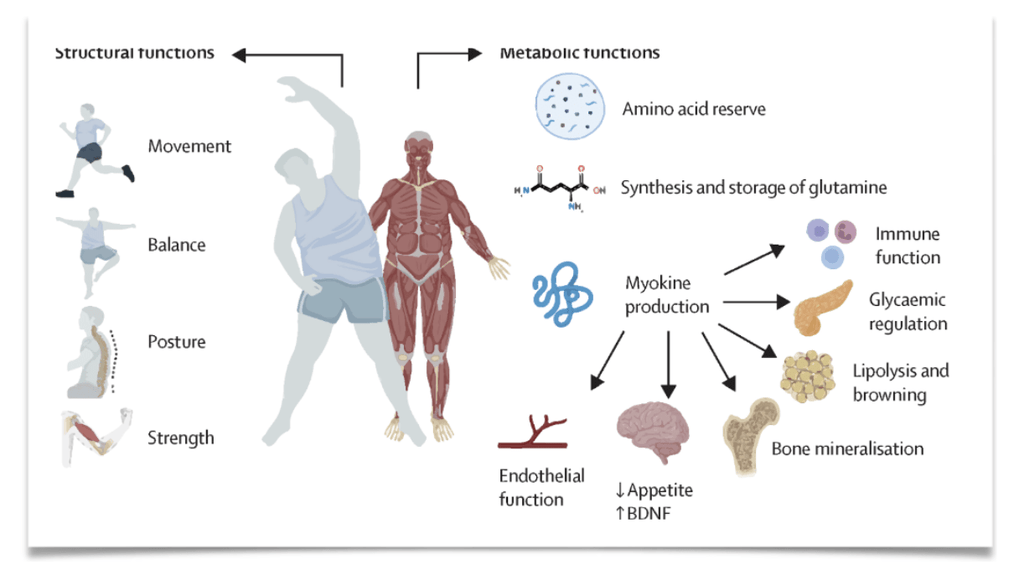
Figure: The dual role of muscle as both a structural/functional and metabolic organ. Functionally, muscles are essential for movement, balance, posture, and strength, which are vital for physical function. Metabolically, muscle serves as a reservoir for amino acids that are crucial for stress response, trauma recovery, and infection management. Muscle also plays a key role in glucose homoeostasis and synthesises glutamine, an important amino acid for nitrogen transport and immune function. The figure further emphasises the role of muscle-derived myokines, signalling molecules that function as endocrine factors facilitating communication between muscle and various organs. This inter-organ crosstalk highlights muscle’s central role in overall metabolic health. Myokines enhance endothelial function, regulate appetite by interacting with BDNF and contribute to bone health by promoting bone mineralisation. Additionally, myokines support lipolysis and the browning of white adipose tissue, which increases metabolic activity and energy expenditure. Adapted from Severinsen et al.(5)
Muscle Mass vs. Muscle Strength: A Complex Relationship
Some experts believe that muscle loss during short-term weight loss may not immediately affect physical performance. That’s because muscle mass and strength aren’t always perfectly linked. A person may lose size but retain function, especially if fat is cleared from within the muscle itself, improving its efficiency.
This concept, which is often referred to as enhanced muscle quality, suggests that not all lean mass loss is equally harmful. For example, myosteatosis, or fat infiltration into muscle, is known to worsen muscle performance and health outcomes. Reducing that fat, even if some muscle volume is lost, could theoretically improve function.
But this remains a hypothesis, and so far, long-term data are limited. What’s clear is that while strength may be preserved in some cases, the metabolic roles of muscle go far beyond movement, and those functions are harder to measure in a clinic.
The Underappreciated Role of Muscle in Health
Skeletal muscle is one of the body’s most metabolically active tissues. It acts as a reservoir for amino acids, helping the body respond to stress, trauma, or infection. It also plays a central role in glucose regulation, helping insulin move sugar out of the bloodstream and into cells. Without sufficient muscle, this system falters, increasing the risk for type 2 diabetes

Muscle also communicates with other organs by releasing myokines.
There tiny signaling proteins that influence energy use, inflammation, and immune function. These chemical messengers help coordinate the body’s response to illness and regulate systemic health(5).
Put simply: muscle is not just for motion, it’s a metabolic and immune organ. And when it’s lost,
the body loses far more than strength.
The Hidden Risk of Sarcopenic Obesity
Most people think of obesity as simply having too much fat. But there’s another condition called sarcopenic obesity, where excess fat is combined with poor muscle quality or low muscle mass. This combination is especially harmful and is linked to higher rates of cardiovascular disease, frailty, infection risk, and early death(6).
Sarcopenic obesity can develop over time, but it may be accelerated by drug-induced weight loss without
attention to muscle preservation. In many cases, when people stop taking GLP-1 medications; whether because of side effects, cost, or a plateau; they regain weight.
But the weight they gain back is usually fat, not muscle.
This cycle of losing weight
(and muscle), then regaining fat, can gradually erode muscle reserves and increase long-term health risks. Over time, this pattern may turn what looks like a successful treatment into a setup for sarcopenic obesity.
What Can Be Done
GLP-1 receptor agonists are powerful tools. They’ve transformed obesity care and provided meaningful benefits to many people struggling with weight-related illness.
But their use requires a strategic approach.
To preserve muscle while losing fat, patients and clinicians should pair these medications with:
- Adequate protein intake
- Resistance exercise, such as strength training or bodyweight workouts
- Ongoing monitoring of body composition, not just weight
Researchers are also studying new treatments that could prevent muscle loss during weight reduction. Two promising candidates, bimagrumab and enobosarm, are in clinical trials to evaluate their ability to preserve or even build muscle while people lose fat(7).
Looking Ahead: The Role of Policy and Research
At this point, we don’t yet know whether GLP-1 medications increase the risk for frailty or sarcopenia
(age-related
muscle wasting) over time. Current studies weren’t designed to answer those questions, and long-term data is lacking.
To address this gap, regulatory agencies and research institutions should:
- Require body composition monitoring in future trials
- Provide clearer clinical guidelines on preserving muscle during weight loss
- Invest in post-marketing surveillance to track real-world outcomes
The goal isn’t to dismiss these medications. In fact, they represent a breakthrough in chronic weight management. But weight loss should improve overall health, not trade one risk for another. By focusing not just on how much weight is lost, but what kind of weight is lost, we can move toward better, more sustainable care.
If you want to give your body a boost to burn more fat without burning through muscle, consider adding
SHREDDED-AF to your daily routine.
SHREDDED-AF is scientifically formulated to accelerate thermogenesis, amplify calorie burning, and support all-day energy without the crash.
Packed with potent ingredients that stimulate brown adipose tissue, increase metabolic rate, and enhance fat oxidation,
SHREDDED-AF is your ultimate weapon for getting lean, shredded, and staying in peak condition.


References:
1. Heymsfield SB: Advances in body composition: a 100-year journey. International Journal of Obesity 49:177-181, 2025
2. Conte C, Hall KD, Klein S: Is Weight Loss–Induced Muscle Mass Loss Clinically Relevant? JAMA 332:9-10, 2024
3. Chaston TB, Dixon JB, O’Brien PE: Changes in fat-free mass during significant weight loss: a systematic review. International Journal of Obesity 31:743-750, 2007
4. Cruz-Jentoft AJ, Gonzalez MC, Prado CM: Sarcopenia ≠ low muscle mass. European Geriatric Medicine 14:225-228, 2023
5. Severinsen MCK, Pedersen BK: Muscle–Organ Crosstalk: The Emerging Roles of Myokines. Endocrine Reviews 41:594-609, 2020
6. Rossi AP, Rubele S, Calugi S, et al: Weight Cycling as a Risk Factor for Low Muscle Mass and Strength in a Population of Males and Females with Obesity. Obesity 27:1068-1075, 2019
7. Prado CM, Phillips SM, Gonzalez MC, et al: Muscle matters: the effects of medically induced weight loss on skeletal muscle. Lancet Diabetes Endocrinol 12:785-787, 2024