
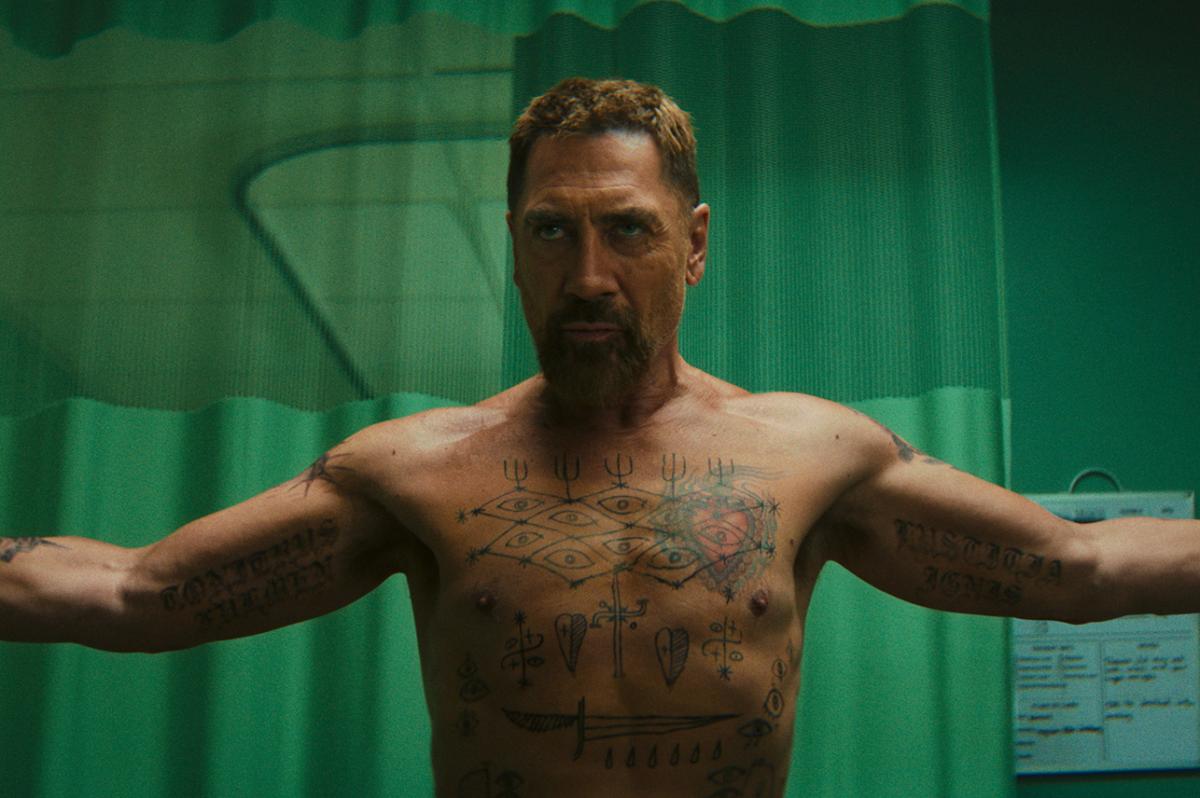
When we open, Max Cady’s life has been turned upside down. Seven years ago, in a flashback sequence depicted in gritty black and white, Max is attacked in the prison weight room by a trio of Nazis. He gets the better of them, definitively killing two of them before passing out from his own head injuries, which we know continue to plague him even now.
But this bare-bones description does not do this cold open justice. Cape Fear has just given us the most brutal television fight scene since the Mountain dueled the Red Viper on Game of Thrones, possibly even since Dan Dority met Captain Turner in the thoroughfare on Deadwood. Simply put, it’s fucking unbelievable.
The key here, besides exceptional fight choreography by Daniel Hargrave and director S.J. Jackson’s thrilling sense of camera movement (it turns out to be just the tip of the iceberg in that sense), is the weapon of choice: kettlebells. They’re the perfect improvised implement of violence: Everyone who’s ever touched one knows they’re light and maneuverable enough to pick up and swing, but heavy enough to absolutely destroy whatever body part they come into contact with on the end of that swing.

Watching Max pulp guys’ legs and knees and skulls with those things — up to and including impaling a Nazi’s face on a barbell with one mighty swing — is not just terrifying, it’s tangible. Even the coup de grace, basically chopping a guy’s head in half with a guillotine-style blow from a weight plate, brings up direct sense memories for anyone who’s ever hoisted one of those things.
It’s a tremendous scene in and of itself, as heavy and violent as Bernard Hermann’s four-note leitmotif. (Heavymotif?) But it’s also pertinent to the central question of the episode: How crazy is Max Cady, and how long has he been that crazy for?
“I don’t think you’re psychotic,” Anna Bowden tells Max when she confronts him at the hospital to which both he and her mutilated son Zack have been brought for treatment. (Max got in a fracas with the cops who came to bring him in for questioning in the Zack attack before he realized they were cops; they’re surprisingly forgiving about this, perhaps because the guy’s just been declared wrongfully imprisoned.) “I think you’re guilty.” So that settles the question of whether or not Anna helped railroad him.
But what if she’s wrong on both counts? “I didn’t start out a motherfucker,” he tells Ruben (Roberto Sanchez), a convict represented by Anna’s SJLP project who’s wavering on fighting for exoneration despite being six weeks away from execution. “They made me a motherfucker. I became a motherfucker to survive….I never killed anyone until they stuck me in this fucking place.”
Is it possible he’s right?

His hallucinatory visions of his late wife (Samantha Clifford) and never-born son (Blaise Reyes) — which he denies having — display no apparent animus toward the woman, and nothing but apparently sincere desire to have fathered and raised the child. All his statements back this up, but of course they would; his inner visions seem less likely to be lies.
Unless they are hallucinations in another way. Could the admittedly emotionally abusive Max have actually forgotten that he committed the crime that sent him to prison after that beating? Would there be any way to square such targeted amnesia with the coached confession and suicide of his mistress? Is the official explanation that the deaths of the freed convict Byron French and his mother were a murder-suicide actually the truth? For that matter, does the presence of another mystery figure, a woman wearing a green hooded coat, sunglasses, and a surgical mask, mean someone else entirely could have been involved in any or all of these incidents too?
We do know that Max has been the girl on the other end of Zack Bowden’s sexts. (It is unknown if Max is also responsible for the gaming component of this catfish, but god I hope so.) Zack is released from the hospital on the theory that he got really high, forgot where he was, tore off his own toe, and swallowed it in front of a makeshift altar in the unused half-finished den of his own family’s home — an explanation both Anna and I, personally, find very hard to swallow. (Sorry.) Anna tricks him into unlocking his phone with facial recognition, then combs through his texts to the mystery girl, hoping to find out if she’s responsible for drugging him.
When Max uses a nearly identical line during an interview as the girl did in one of their chats, Anna realizes what’s going on. Once again, Max wants her to know what he’s up to, since he realizes she’ll sound paranoid if she brings it up. (Both he and showrunner Nick Antosca want us to know the Bowdens have a cat, too, which makes me deeply uneasy.) Sure enough, Anna doesn’t say a word about this to Tom. Tom, however, has secrets of his own, like whatever he’s microdosing with that tincture of his, leading to spaced-out sun-soaked vistas within the confines of his own cozy home.
Let’s talk about that home for a moment. What a fascinating set! The wallpaper on the big curving staircase is a mural of verdant trees, making it look like these people live in the jungle. Half the house is unfinished, just wood and plastic tarps, like the house in which the menacing Leo Johnson abused his wife Shelly in Twin Peaks, or the many under-construction houses that show up in stories about hauntings. The back porch is so splendid that you practically have to descend the Odessa Steps to reach the actual yard and pool. Can you wring Southern Gothic out of nouveau riche? We’re about to find out.
The riche is definitely nouveau on Anna’s side of the family at least. Her father, Brandon (Ted Levine), shows up in a pickup truck, dropping off a pair of soccer cleats for Natalie’s long-ago birthday in the middle of the night. Apparently bipolar and unmedicated, he’s been cut off by Anna, and Tom refuses even to tell her he’s visited.
But the generation gap cuts both ways: Natalie and Zack, who’ve been distant for some time, bond over their shared lack of connection with their parents. Each kid has their own advantages and their own baggage in this arrangement. Natalie is a star athlete and student who feels invisible at home, and who seems to be struggling to come out, as a sweet, hot, cut-short scene with her pretty stoner best friend makes clear.

By contrast, Zack has his parents’ attention — but that’s because he leaked his girlfriends’ nudes to a group chat, leading to his ostracization from his friend group and punishment at school. It also seems like there’s some behind-closed-doors secret in his recent past that has yet to be revealed. “Mom and Dad don’t know us,” Zack says, “and we don’t know them.”
For her part, Natalie tells Zack to stop trying to contact his ex to apologize, as there’s simply no way to make up for the crime he committed. He just has to move on. But Cape Fear, you may have noticed, is not a story that’s big on people “moving on,” and Natalie also overhears Tom and Anna talking about how “no one knows but us” “what we did.” I don’t get the feeling this seemingly whip-smart teenager is going to be letting go of that morsel anytime soon.
Max had it considerably worse than either Bowden kid growing up, though he expresses a sense of connection with Anna over their shared experience with “difficult childhoods, difficult fathers.” But that’s understating the case by a long shot where Max is concerned. The child of an American serviceman stationed in Spain, he was neglected and abused by his suicidally depressed mother until she killed herself when he was 13. He was sent to live with his father, who taught him no English and very literally kept him in a cage, perhaps as punishment, perhaps in general. He also baptized the kid, but you’ll find no Christian iconography in Max’s tattoos: Just the grim reaper, and dozens and dozens of eyes.
The episode ends with Max and his big new slobbery dog — he hoodwinks some asshole who kept it chained up into trading it for a nonexistent dog at the local shelter named, in Spanish, “Your Dick” — offering to buy a brand new house with his settlement money, and making the real estate agent deeply uncomfortable. He settles in alone to “get a sense of the place,” once again seeing his wife and son. If I were a betting man, I’d say Tom and Anna have a new neighbor.
Watching the meticulous way writers Maria and André Jacquemetton execute the mystery-thriller plot beats and jump scares while constantly seeding new questions is only part of the Cape Fear experience, though. The rest is like the visual equivalent of the theme song. This show doesn’t so much cut from scene to scene or shot to shot as it reels, like a man on the deck of a storm-tossed ship. Match cuts, whip zooms, focus pulls, whip pans, dolly zooms, oodles of exciting in-camera lighting choices — this thing is like a film studies textbook come to life, with director Jackson, cinematographer Celiana Cárdenas, and editor Darrin Navarro seeming as drunk on the stylistic boldness of classic thrillers as prime Brian De Palma.
It’s a crowded season for horror on TV right now. But I’d keep my eyes on this one.

Sean T. Collins (@seantcollins.com on Bluesky and theseantcollins on Patreon) has written about television for The New York Times, Vulture, Rolling Stone, and elsewhere. He is the author of Pain Don’t Hurt: Meditations on Road House. He lives with his family on Long Island.