
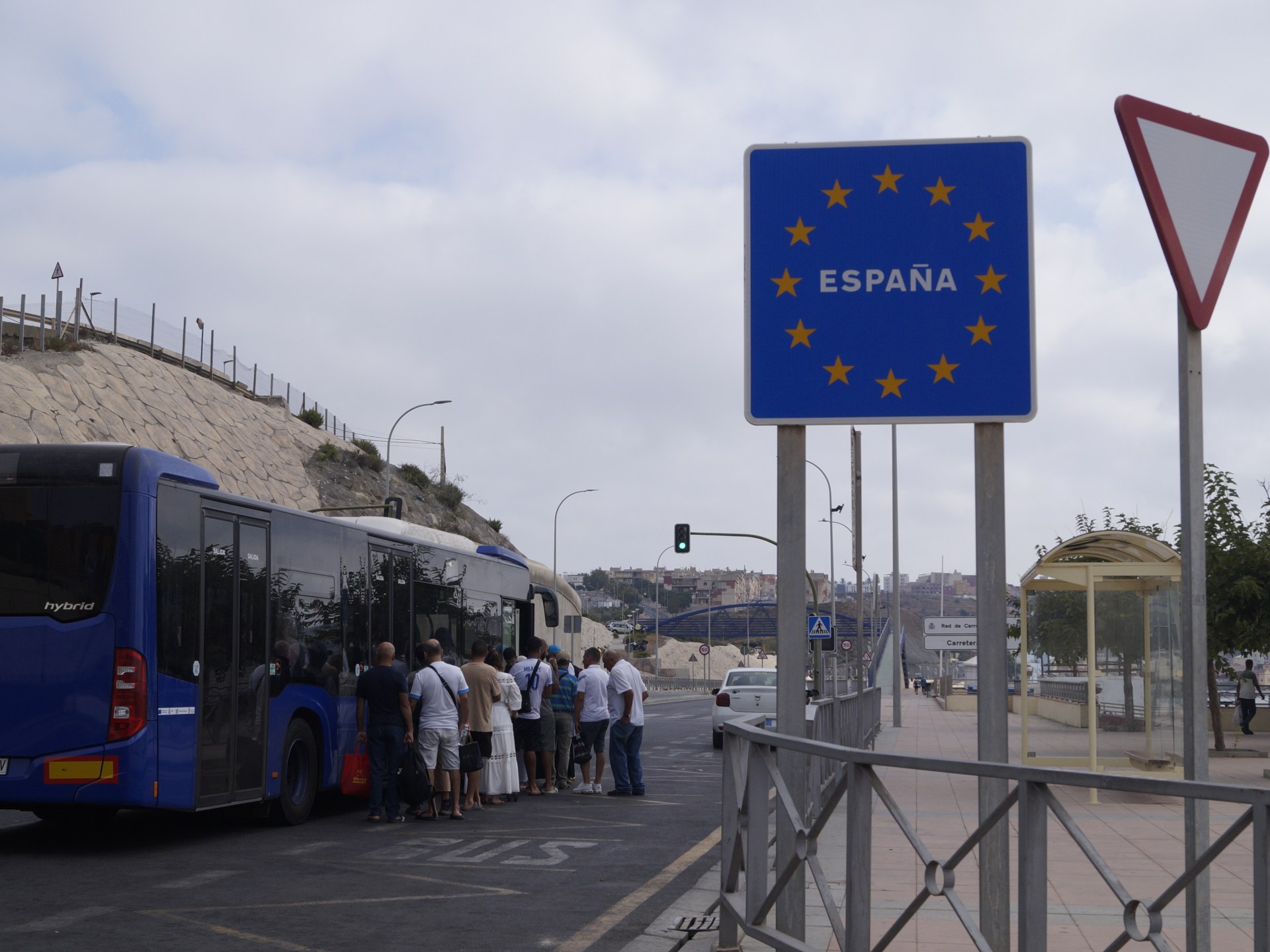
Spain’s two tiny enclaves on the north coast of Africa have long been a flashpoint in its relationship with Morocco, which the territories border.
The only such European territories on African soil, they include the autonomous city enclaves of Ceuta and Melilla, as well as Plazas de Soberanía – a group of rocky islands off the Moroccan coast, which include the Chafarinas Islands, Alhucemas Islands and Penon de Velez de la Gomera.
Recommended Stories
list of 3 itemsend of list
While Spain says it owns these enclaves, Morocco does not recognise Spain’s sovereignty over them and has been demanding their return since independence from France in 1956.
The territorial dispute has resulted in long-standing political tensions between Spain and Morocco.
Last week, after more than 50,000 migrants surged over the border into the Spanish enclave of Ceuta, those tensions between Madrid and Rabat intensified. While most have since returned to Morocco, several thousand remain in Ceuta this week.
So why does Spain have these territories at all and what does their future hold?
Here’s what we know:
Why does Spain have enclaves in North Africa?
The enclaves of Ceuta and Melilla, along with a few islets off the coast of Morocco, constitute the last vestiges of the Spanish colonial empire.
Ceuta first came under Portuguese rule in 1415 before becoming part of Spain in 1580, while Melilla was conquered by a Spanish nobleman in 1497. Ceuta remained under Spanish control after Portugal regained independence in 1640 following a long war.
“Spain reached its greatest extent in Latin America, and with the loss of Cuba, Costa Rica and the Philippines in 1898, it shifted its influence to Africa, although most European colonial powers had already divided it among themselves,” explained Yolanda Aixelà Cabré, an anthropologist at IMF-CSIC in Barcelona.
After the decolonisation of Africa in the last century, Ceuta and Melilla remained the only European-held territories on the African mainland. Although geographically in Africa, the enclaves are considered Spanish territory and form part of the EU’s external border.
“For Spain, maintaining these enclaves [on the northern coast of Africa] is fundamental on a symbolic level because they reinforce Spanish grandeur, its imperial past which the State continues to consider a bearer of civilisation in contrast to barbarism, a notion perfectly encapsulated by the repetitive discourse that [Christopher] Columbus, representing the Catholic Monarchs, ‘discovered’ America,” she said.
Why didn’t the enclaves pass to Morocco on independence?
Selim Balouati Lakhloufi is a historian and researcher specialising in the history of North Africa and the Rif mountainous region in northern Morocco, which stretches along the Mediterranean coast from Tangier to the border with Algeria. He said Ceuta and Melilla continue to exist as separate territories because their origins “predate modern Morocco”.
“They are enclaves that have been occupied for centuries,” he told Al Jazeera.
But since gaining independence from France in 1956 – which Spain recognised while retaining its enclaves – Morocco has consistently maintained that the territories of Ceuta and Melilla, which it calls “Sebtah and Melilah”, and the Plazas de Soberanía, are part of its territory and has been demanding their return.
“This has always been used by the Moroccan political class as a point of criticism against Spain,” Lakhloufi said.
Samir Bennis, a Washington, DC-based senior political adviser who is also the co-founder of Morocco World News and an expert on Morocco’s foreign policy, said since independence, Morocco’s territorial claims over Ceuta and Melilla have frequently been at the centre of tricky relations between Spain and Morocco.
“Perhaps this issue would not have had the same detrimental effect on bilateral relations had Moroccan leaders shown greater determination in the early 1960s, during the height of the decolonisation period, to bring the matter before the United Nations and seek recognition of these two cities as colonial territories that should be liberated from any foreign presence,” he said.
He explained that there are, however, two important factors which led the Moroccan authorities to refrain from pursuing this course in their efforts to restore the country’s territorial integrity.
“The first was the sheer scale of the territorial disputes between Spain and Morocco. Given the difficulty Morocco faced in simultaneously contesting Spanish control over several territories, the Moroccan government decided to proceed gradually in its efforts to recover the parts of Moroccan territory that remained under Spanish rule.”
“The second factor that led the Moroccan leadership to postpone addressing the question of Ceuta and Melilla was the willingness shown by the Spanish authorities to resolve their territorial disputes with Morocco progressively. In the end, this strategy proved highly beneficial for safeguarding Spain’s interests in the two cities,” Bennis added.
How strong is Morocco’s claim to these enclaves?
Morocco’s claim to the territories is relatively weak, Bennis said. But “the country can invoke a range of historical, geographical and human arguments that cast doubt on Spain’s position”.
Jamie Trinidad, a fellow and director of studies in law at Wolfson College, Cambridge University, also said that Morocco’s claim to the territories is weak under international law. “It is a political, rather than a legal, claim, similar to Spain’s claim to Gibraltar, which lies across the strait from Ceuta,” he said. Gibraltar is a British Overseas Territory.
“In the 1970s, Morocco asked the UN to include the territories on the list of ‘Non-Self-Governing Territories’ overseen by the UN’s Special Committee on Decolonisation, but the Moroccan request was ignored by the UN,” he added.
What do people living in these enclaves want?
Around 84,000 people live in Ceuta and 86,000 in Melilla.
In Spanish possession since 1580, Ceuta is home to a mixed population of Christian and Muslim, Spanish and Moroccan residents and day workers who live and work in relative harmony.
But after more than 50,000 migrants entered Ceuta illegally last week, divisions and tensions in the enclave have risen.
Hundreds of residents rallied on Sunday – two days after the surge of migrants to Ceuta – to oppose a planned far-right anti-migrant rally, forcing organisers to cancel the event.
“I am half Christian, half Muslim, as many in Ceuta are. We live peacefully together. But the numbers this time were scary,” Ceuta resident Isabel told Al Jazeera over the weekend.
Melilla, which has been in Spanish possession since 1497, is also home to Spanish and Moroccan residents, as well as small Jewish and Sindhi communities, the latter a diaspora of Hindu merchants who arrived following the 1947 partition of India.
The Plazas de Soberania is mainly populated by Spanish military personnel.
Lakhloufi noted that polling shows an overwhelming majority of people living in Ceuta and Melilla wish to remain part of Spain.
“This has been reflected consistently in public opinion and in the absence of any significant political movement advocating a change in sovereignty,” he said. “Even the population with Moroccan origin want to stay as Spanish and European. This is because the social welfare difference between Morocco and the cities it’s really high,” he said.
“At the same time, both cities maintain strong historical, cultural and economic ties with Morocco, making cooperation across the border an important aspect of daily life,” he added.
According to the Spanish government, Ceuta and Melilla are part of the Schengen area, which guarantees freedom of movement within the EU, but are subject to a special Schengen regime. People travelling between the enclaves and mainland Spain undergo separate border checks.
“Schengen checks are carried out on exit by sea or air, the only two routes available. Therefore, no one can travel from Ceuta or Melilla to mainland Spain without being identified by the National Police at the port or the airport. In addition, ferry operators and airlines are required to verify travel documents,” a Spanish government document states.
Will Spain give up these enclaves?
Analysts are divided.
In March 2022, Spanish Prime Minister Pedro Sanchez wrote to the Moroccan king, confirming Spanish support for Moroccan sovereignty over the Western Sahara, which Spain gave up control of in 1975. Sanchez said this was “the most serious, realistic and credible” initiative for resolving the decades-long dispute over the vast African territory and declared “a new stage” in Spain’s strained relations with Morocco.
Cabre said, therefore, that after last week’s overwhelming migrant influx into Ceuta, Spain could ultimately cede sovereignty to Morocco.
“Their [the enclaves] mere presence is an unsustainable historical anomaly at a time when the decolonisation of European states is being promoted at all levels, like European countries returning of items stolen during colonialism and recognising the citizenship rights of their former colonies,” she said.
But Lakhloufi does not expect a fundamental change in Spain’s policy on the enclaves.
“What may change is the way Spain manages its relationship with Morocco, particularly regarding border management, migration and security cooperation. However, tactical adjustments should not be confused with a shift in Spain’s long-standing position on sovereignty. It’s usually Morocco that puts pressure on the borders, not Spain,” he said.