
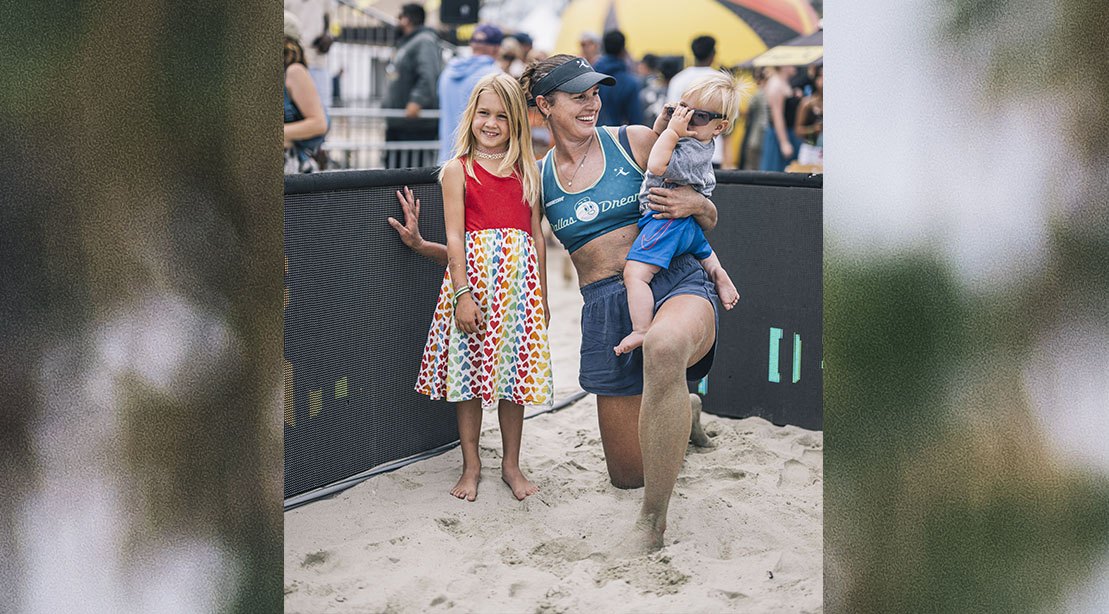
For most elite athletes, success is measured in championships, rankings, and podium finishes. For seven-time AVP champion Betsi Flint, those accomplishments still matter, but today, they’re no longer at the top of the list.
“I love when they introduce me as a mom of two,” Flint tells Muscle & Fitness. “That holds a lot more weight to me than any other accolade.”
After taking the 2025 AVP season off following the birth of her son, Odin, Flint has returned to competition this year with the Dallas Dream, competing in Miami, Las Vegas, and Long Beach while navigating one of the most demanding balancing acts in professional sports: raising two young children while chasing another championship.
The comeback has been anything but easy.
With daughter Cora now 5 years old and Odin still an infant for much of her return, Flint says volleyball has shifted from being the center of her world to fitting into a life built around family.
“Family is my main priority right now,” she says. “Volleyball is awesome, and it gives me a great outlet. I’m giving as much as I can right now, but I know at some point I’ll be able to give more to volleyball.”
That perspective has transformed the way she approaches both motherhood and performance.
The Reality Behind the Comeback
From the outside, elite athletes often make postpartum returns appear effortless. Flint wants people to know the reality looks much different.
Earlier this season, she was pumping breast milk before matches, storing it between games, and traveling with everything necessary to continue breastfeeding while competing at the highest level. She recently completed that chapter, but the challenges extended far beyond logistics.
Her second pregnancy proved significantly more difficult than her first after developing severe iron deficiency that required infusions late in pregnancy.
“I had no energy,” Flint recalls. “I would sit down and fall asleep. Some doctors told me it was just normal pregnancy, but it didn’t feel normal.”
The difficult pregnancy delayed her physical return to competition.
“I had to really rebuild, and it took a little longer than the first time around,” she says. “But that’s okay.”Even after returning to the sand, Flint says she had to accept that her body wasn’t immediately capable of doing what it once could.
“I want to do things that I used to do, but I’m not doing them. I’m not jumping as high, running as fast, or hitting as hard yet.”
Instead of chasing perfection, she’s learned to celebrate weekly progress.
Building a Better Support Team
One of the biggest lessons Flint has learned through two postpartum comebacks had little to do with lifting heavier, jumping higher, or logging more hours in the sand. Instead, it was about surrounding herself with the right experts. People who understood the unique physical demands of returning to elite competition after childbirth.
While she’s long worked with world-class strength coaches and athletic trainers, Flint says adding a pelvic floor physical therapist to her support team fundamentally changed her recovery process.
“I had some of the best strength trainers and athletic trainers in the world,” Flint says. “But finding a pelvic floor physical therapist that understands women coming back after having babies made such a difference.”
For Flint, the value wasn’t just in rehabilitation exercises. It was having someone who understood the hormonal shifts, joint instability, and gradual rebuilding process that many postpartum athletes experience but isn’t always accounted for in traditional high-performance training programs.
She admits one of the biggest surprises after her second pregnancy was just how physically achy she felt while breastfeeding. Her therapists reassured her that the discomfort was a common response to postpartum hormone changes and helped her work through those challenges without feeling like something was wrong. That guidance gave her confidence to trust the process instead of rushing it.
Patience, however, doesn’t come naturally.
“I’m not a patient person,” Flint says with a laugh. “Sometimes my strength coach has to slow me down because I want to lift heavier and get stronger faster.”
Like many elite competitors, she’s wired to push through discomfort and chase progress. But this comeback required a different mindset. Rather than forcing her body to return on her timeline, Flint had to accept that sustainable progress sometimes meant slowing down. Her coaches continually reminded her that rushing the process could ultimately delay it, while small, consistent gains would build a stronger foundation for the long season ahead.
That lesson has carried beyond the weight room. Instead of comparing herself to the athlete she was before pregnancy, Flint now focuses on incremental improvement, celebrating the weekly gains in strength, power, and confidence that remind her she’s moving in the right direction. For an athlete accustomed to chasing championships, learning to embrace gradual progress may have become one of the most valuable victories of all.
Adaptability Is the Ultimate Competitive Advantage
Success in professional beach volleyball isn’t determined solely by talent. It’s often decided by an athlete’s ability to adapt. Unlike indoor volleyball, where conditions remain largely controlled, beach volleyball demands constant adjustments to the environment. One weekend may bring suffocating humidity, another blistering heat, and the next unpredictable wind or shifting sand.
For Flint, adapting has become second nature.
During the 2026 AVP League season, she’s already navigated the humid conditions of Miami, the extreme desert heat of Las Vegas, and the familiar beaches of Long Beach, with each venue presenting its own set of physical and mental challenges. Rather than allowing those variables to become distractions, Flint has learned to embrace them.
“You never try to dwell on what’s going wrong,” she says. “If we’ve got 30-mile-an-hour winds, let’s go.”
That mentality was especially important in Las Vegas, where temperatures soared on courts built over blacktop parking lots. Instead of following their normal 45- to 50-minute warm-up routine, Flint and her teammates adjusted on the fly, shortening their preparation to conserve energy before stepping onto the scorching sand.
For Flint, those decisions are less about reacting and more about controlling what she can control. Weather, venue changes, and playing conditions are simply part of the job. The athletes who perform best, she believes, are the ones who quickly shift their focus from obstacles to execution.
That same adaptability extends to the AVP League’s innovative competition format.
Unlike traditional tournaments, the league features shorter races to 15 points, one scheduled match per day, and greater consistency in start times. The changes may seem subtle, but they significantly alter how athletes prepare both physically and mentally.
“It’s nice to know what time we’re playing, and we know we’re playing one match a day,” Flint says. “I think you get to see the best performance then, versus when we play tournaments where you’re physically exhausted by the end.”
Instead of conserving energy for multiple elimination matches over the course of a day, Flint can devote her attention to arriving fully prepared for a single, high-level performance. The result, she says, is a style of competition that showcases the sport at its highest level, allowing fans to see elite athletes competing closer to full capacity rather than simply surviving the grind of tournament play.
Whether she’s adjusting to unpredictable weather, a new competition format, or the daily demands of motherhood, Flint has discovered that adaptability isn’t just a valuable skill. It’s become one of the defining characteristics of her longevity. And after more than a decade competing among the world’s best, it’s a mindset that continues to separate champions from the rest.
Longevity Comes From the Little Things
Seven AVP titles weren’t built on talent alone.

Flint believes longevity is the product of consistently doing the small things well: nutrition, recovery, mental preparation, and disciplined training. “I feel like I’ve always just tried to do all the little things right and maximize every little aspect,” she says—sleep included, though as a mom of two, that’s the one area she admits she has to sacrifice most.
Today, that routine starts before sunrise.
She’s usually awake between 5 and 6 a.m. with her children before heading to volleyball training, followed by strength work or physical therapy. By early afternoon, she’s home again, fully transitioning into mom mode.
“There isn’t much sitting down anymore,” she jokes. “Sometimes my conditioning is just chasing my daughter on her bike.”
Meal preparation has become another essential performance habit.
Although she laughs at calling herself a chef, Flint says having healthy meals ready removes unnecessary decisions during busy days, allowing her to focus on training and family instead of scrambling for food. A postpartum meal-prep partnership was, in her words, something she “wouldn’t have survived without”—one less thing to think about so she could pour her energy into training and her kids.
But longevity isn’t just physical upkeep; it’s a mindset shift that’s come with experience.
“I think, especially in our sport, experience goes a long way,” Flint says. “I feel like now I’m working smarter, not harder. That’s hard to understand when you’re young. When I was younger, I was like, yeah, you have time, you can do it all. But now it’s just about maximizing the time I do have.”
That philosophy extends to how she thinks about longevity for the next generation of athletes, too. Flint points to early specialization as one of the biggest career-shorteners she sees in young players. The same repetitive movement patterns, tournament after tournament, without cross-training or rest. Her own background playing indoor volleyball, basketball, and softball growing up, she says, is part of why her body has held up: different movement patterns, less overuse, less burnout.
And when the tank runs low, she leans on a support system rather than sheer willpower alone, a sports psychologist, trusted strength staff, and a pelvic floor physical therapist she credits as essential to her postpartum comeback. “It’s easy to take days off if you want, and for sure you need days off,” she says. “But sometimes you just gotta push through a little bit.”
Success Looks Different Now
Perhaps the biggest transformation in Flint’s career isn’t physical; it’s mental.

Instead of defining success by wins and losses, she measures it by showing up with whatever she has that day.
“Some days I’m feeling 60 percent,” she says. “Success is bringing all of that 60 percent.”
It’s a philosophy born from sleepless nights, long travel days, motherhood, and years competing at the sport’s highest level. It’s the same mindset that got her through iron infusions and an 18-month return to competition that took longer than she wanted, through pumping breast milk between matches at her first AVP qualifier back, through a first-round exit as the No. 1 seed that turned into a title run anyway. Flint has learned, match by match and year by year, that resilience isn’t about feeling ready. It’s about showing up anyway.
That shift shows up in how she talks about the next generation, too.
Her advice to her younger self—the one chasing every title, comparing herself to every competitor—is simple: stop comparing, focus inward, and trust that no two paths look the same.
It’s advice she’s now living out in real time, in a sport where she admits she’s no longer the fastest or the highest jumper on the court, but she’s the one who knows exactly what winning actually requires.
When Flint eventually steps away from professional volleyball, she hopes fans remember more than the championships.
“I’d love to be remembered as someone who was a great teammate and brought the best out of her partner,” she says. “And someone who had the perseverance to keep going after having kids.”
She lights up talking about being introduced on stadium courts as a mom of two, a title, she says, that carries more weight than any trophy. It’s there in the small moments too: her five-year-old daughter pulling on a miniature Dallas Dream jersey, staging her own matches in the living room, already dreaming in her mother’s footsteps.
Judging by the example she’s setting this season, Flint is already accomplishing exactly that – not despite motherhood, but because of everything it’s taught her about what longevity and success really mean.