
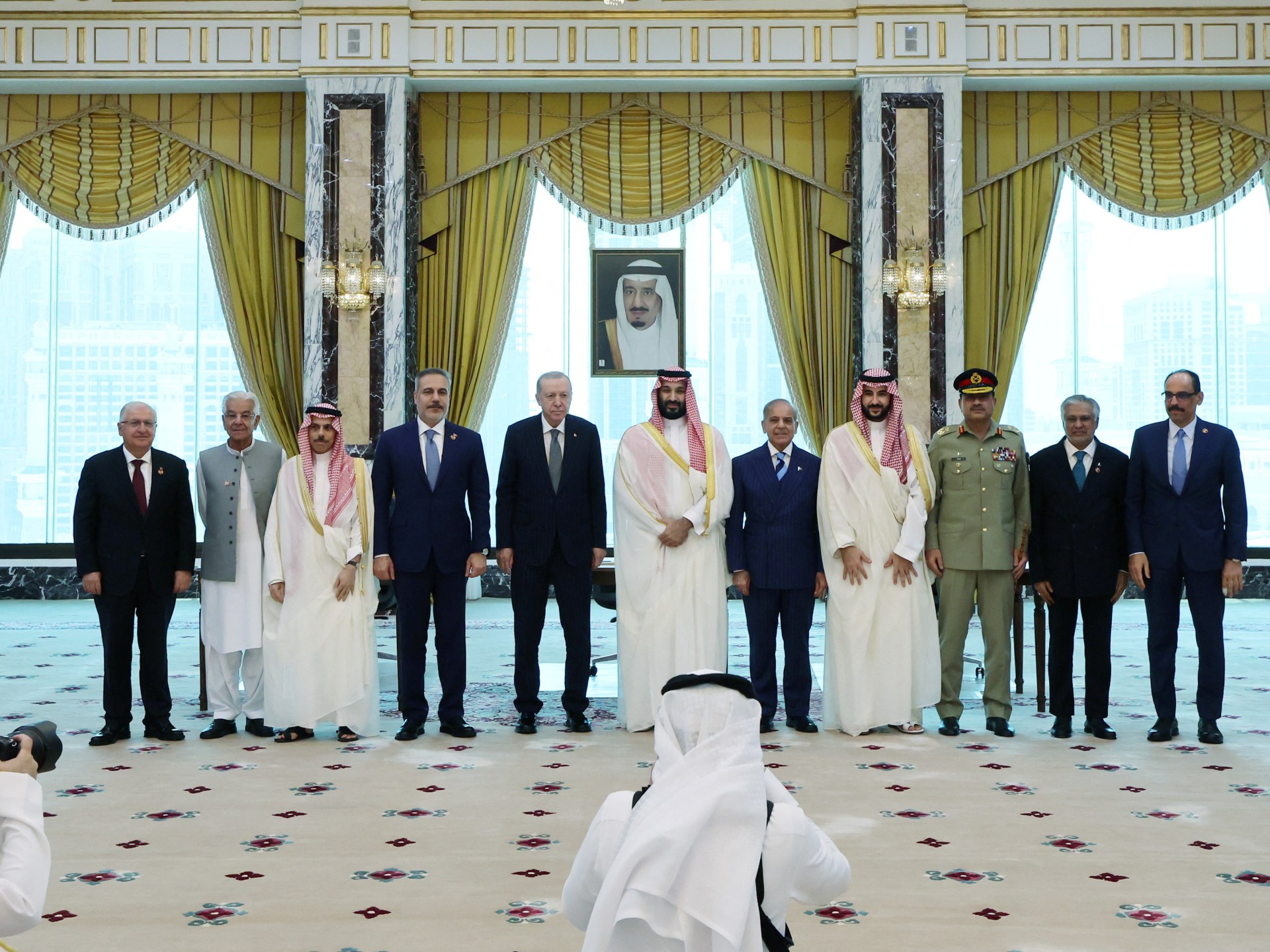
Saudi Arabia, Pakistan and Turkiye have signed a joint defence pact as tensions in the Middle East continue to escalate with the United States and Israel’s war on Iran.
The agreement, called the Mecca Joint Deterrence Agreement, was signed in the Saudi holy city of Mecca on Friday by Turkish President Recep Tayyip Erdogan, Saudi Crown Prince and Prime Minister Mohammed bin Salman and Pakistani Prime Minister Shehbaz Sharif.
Recommended Stories
list of 3 itemsend of list
The pact is intended to provide a collective deterrence against any act of aggression by stipulating that an armed attack against any of the three would be regarded as an attack on all, the partners said jointly.
In a statement of its own, the Pakistani Ministry of Foreign Affairs said the joint defence deal signed was “guided by the longstanding historical ties among the three states, based on the enduring bonds of brotherhood and Islamic solidarity that unite them, and building upon their shared strategic interests and longstanding defence cooperation”.
The agreement reflects “the three states’ shared commitment to further strengthening their collective security and to promoting peace, security, and stability in the region and beyond, in pursuit of a secure and prosperous future”, it added.
The deal comes a day after Pakistani Prime Minister Shehbaz Sharif, accompanied by powerful army chief Asim Munir, arrived in Saudi Arabia and performed the Umrah pilgrimage in Mecca.
Turkish President Recep Tayyip Erdogan also travelled to Saudi Arabia on Friday to meet Saudi Crown Prince Mohammed bin Salman.
Here’s what we know about what this pact contains:
Why has this pact been made now?
The defence agreement between Ankara, Riyadh and Islamabad has been in the making for some time. Negotiations began soon after the October 7, 2023 Hamas attack on Israel and the onset of the subsequent Israeli genocide in Gaza, and gained pace amid the US and Israel’s ongoing war on Iran.
While Turkiye and Pakistan have not been directly impacted by tensions in the region so far, Saudi Arabia, which hosts US military assets and infrastructure, has come under attack from Iran and its allies, the Houthis in Yemen. Tehran has also attacked other Gulf nations and Jordan, which also host US military assets.
But the three nations have been particularly concerned about the impact of Iran’s war and Israel’s growing influence – and attacks – on the region. Israel has occupied roughly one-fifth of Lebanon as it allegedly targets strongholds of the Lebanese armed group, Hezbollah, which is also backed by Iran. Meanwhile, Iran-backed groups in Iraq have been accused of carrying out drone attacks in Saudi Arabia and have, themselves, come under fire from US and Israeli attacks.
Reporting from Ankara, Turkiye, Al Jazeera’s Resul Serdar said that, according to officials there, the escalating regional tensions have indeed forced the countries to come together.
“Post-October 7 has changed the region dramatically, with the Israeli actions and expansionism. And now there is the crisis in the Strait of Hormuz and ongoing attacks on Iran, as well as Iran’s response to the regional countries,” he said.
“So there have been several layers of necessity converging, and forcing these three big countries to come together and sign this binding agreement,” he added.
On March 19 this year, the foreign ministers of Turkiye, Pakistan and Saudi Arabia met in Riyadh during an Islamic summit, in which they discussed what a joint security agreement could look like.
Before this meeting, in September 2025, Pakistan and Saudi Arabia also signed a mutual defence agreement. The agreement came in the wake of an Israeli attack on the Qatari capital, Doha, on September 9, 2025.
Ozgur Unluhisarcikli, the managing director of the German Marshall Fund of the United States’ South and Wider Europe office and the regional director for Turkiye, told Al Jazeera that this defence deal reflects a growing desire for greater regional strategic autonomy at a time when confidence in the existing security order has eroded.
“The three countries also share a broadly state-centric view of regional stability. Despite their differences, they tend to see strong central governments, territorial integrity, and functioning state institutions as the foundation of order, while viewing state fragmentation, civil conflict, and the empowerment of non-state actors as sources of long-term instability,” he said.
What does this pact do?
The trilateral deal is understood to build on a pact already in place between Ankara and Islamabad. It will harness the military and financial strengths of each country, analysts say. While Turkiye has NATO’s second-largest military, Saudi Arabia is the world’s top oil exporter, and Pakistan is the only Muslim nation with nuclear weapons.
Unluhisarcikli said the three partners bring complementary strengths, “including Turkey’s defence-industrial capabilities, Saudi financial muscle and influence, and Pakistan’s military experience and strategic deterrent”.
“It should be noted that this is a framework for closer strategic, military, and defence-industrial coordination among three influential regional powers and not a mutual defence pact that can be compared to NATO,” he added.
Murat Aslan, an associate professor of international politics at Hasan Kalyoncu University in Gaziantep, Turkiye, told Al Jazeera the pact can also be expected to cover “capacity building”.
“We know that Saudi Arabia is dependent on importing their defence products, weapons or equipment, especially from the United States for decades, and we know that it’s not cost-effective and they need to build their own defence sector inside Saudi Arabia,” Aslan said.
“Turkiye and Saudi Arabia share two different issues: First of all, Iran, and you can add Pakistan to that… have shared borders and there is a great sense of threat in the minds of Saudis that Iran may have an impact on their security, so this pact will somehow [expand] their security,” he added.
Reporting from Doha, Al Jazeera’s Osama bin Javaid said the deal essentially puts three of the largest Muslim populations together on the roadmap for joint peace, to deter any act of aggression against them, to ensure they are “in tune” with each other when it comes to intelligence sharing, and to enhance cooperation in other areas including energy, defence expenditure and manufacturing.
“The three of them combined now present a force that will take this region towards a different security architecture than the one in place over the last few decades, especially in the wake of the Iran war,” he said.
How has Iran reacted to this agreement?
There has been no official statement from the Iranian leadership.
However, Iranian MP Ebrahim Rezaei criticised the pact in a post on X on Friday.
“Saudis must know that a paper agreement with Türkiye and Pakistan will not bring them security, just as years of one-sided dependence on the Americans did not bring them security,” he wrote.
“Reform your policies so that you do not need to beg for security from others.”
What does this pact mean for Israel?
So far, neither Israeli Prime Minister Benjamin Netanyahu’s office nor the Israeli Ministry of Foreign Affairs have commented on the new defence pact between Saudi Arabia, Turkiye and Pakistan.
A Turkish official told the Reuters news agency on Friday that the agreement between the three nations is defensive in nature and not directed at any specific actor. It is also open to other regional countries.
However, the three nations are known to have been particularly concerned about Israel’s influence and recent growing attacks in the region.
In early July, speaking alongside Pakistan’s Sharif in Istanbul, Turkish President Recep Tayyip Erdogan said peace efforts in the Middle East would not succeed without regional backing and added that Israel must not be allowed to “dynamite” a US-Iran deal.
“We are closely following the Israeli administration’s attempts to dynamite the (US-Iran) deal … The current war-addicted Israeli government must not be allowed to drown our geography in the smell of gunpowder and blood again,” he said.
The Turkish leader has repeatedly accused Israel of trying to undermine the US-Iran Memorandum of Understanding, which was signed on June 17 to halt fighting and allow time for negotiations.
Erdogan has also repeatedly condemned Israel’s attacks in Gaza, Lebanon and Syria.
For its part, Pakistan has condemned Israel’s genocidal war on Gaza, where more than 71,000 people have been killed in attacks since October 2023, including more than 1,000 since a supposed US-brokered ceasefire was announced last year. It has also condemned any notion of a so-called “Greater Israel”.
But in the US and Israel’s war on Iran, Pakistan has taken on the role of mediator, striving to prevent a regional war.
US President Donald Trump has long hoped to persuade Saudi Arabia to sign the so-called Abraham Accords, normalising relations between Israel and Muslim countries. But Saudi Arabia has also repeatedly condemned Israel’s actions in Gaza and the occupied West Bank and insisted it will not do so until there is a clear path for Palestinian statehood, which Israel’s current government staunchly opposes.
In a July 20 report, Yasmine Farouk, the project director for the Gulf and Arabian Peninsula region in the International Crisis Group, wrote that closer defence ties between Turkiye, Pakistan, Saudi Arabia and also Egypt reflects a hard-won realisation among these four states that “security in their neighbourhood can no longer be left at the mercy of rivalry between the US and Israel, on one side, and Iran, on the other.
“Many officials in these countries had reached this conclusion before the US and Israel launched their assault on Iran in late February. But the war and subsequent Iranian retaliation, including both missile and drone strikes on Gulf Arab states and closure of the Strait of Hormuz, lent it fresh and urgent impetus,” she said.
She noted, however, that several Israeli and US commentators and officials have cast these nations’ joint security dynamics “as an anti-Israel or anti-Israel/UAE bloc of Sunni states”.
In February this year, during a conference in Jerusalem, former Israeli Prime Minister Naftali Bennett alleged that Turkiye is “the new Iran” and said Ankara is trying to turn Saudi Arabia against Israel and build a hostile Sunni axis with Pakistan.