
Asia suffered some of the worst economic fallout when the United States and Israel went to war with Iran six months ago.
The region is heavily reliant on Gulf oil and gas that normally flows through the Strait of Hormuz, where shipping has been reduced to a trickle by Iranian attacks and a US naval blockade.
Recommended Stories
list of 4 itemsend of list
Asian countries quickly imposed fuel conservation measures as oil and gas prices surged, ranging from price caps to alternate driving days and work-from-home mandates for civil servants.
In the months since, Asia has begun seeking a more permanent solution to the biggest energy disruption in history – keeping the oil and gas it needs much closer to home.
“The crisis is producing two very different kinds of investment: infrastructure that bypasses geopolitical risk, and infrastructure that eliminates exposure to imported fuel altogether,” said Parul Bakshi, a visiting research fellow at the Oxford Institute for Energy Studies.
One of the most ambitious proposals to emerge from the crisis has come from Japan.
Though highly dependent on Middle Eastern energy, Japan has weathered the crisis better than many other economies because it holds one of the world’s largest strategic oil reserves.
Tokyo wants its neighbours in Southeast Asia to follow its lead.
In April, Japanese Prime Minister Sanae Takaichi announced the $10bn POWERR Asia initiative, aimed at helping Southeast Asian economies procure oil and petroleum products and, in the long-term, build up strategic stockpiles.
At the outbreak of the Iran war in late February, Vietnam only held enough oil in its national reserves to meet the country’s needs for five to seven days, according to state media, although commercial inventories and other sources extended supplies for up to another 65 days.
Thailand held about 61 days of reserves across the public and private sectors against a 25-day mandated minimum in early March, while the Philippines was estimated to have 50-60 days of supplies in private commercial inventories.
All figures were below the International Energy Agency’s 90-day minimum benchmark.
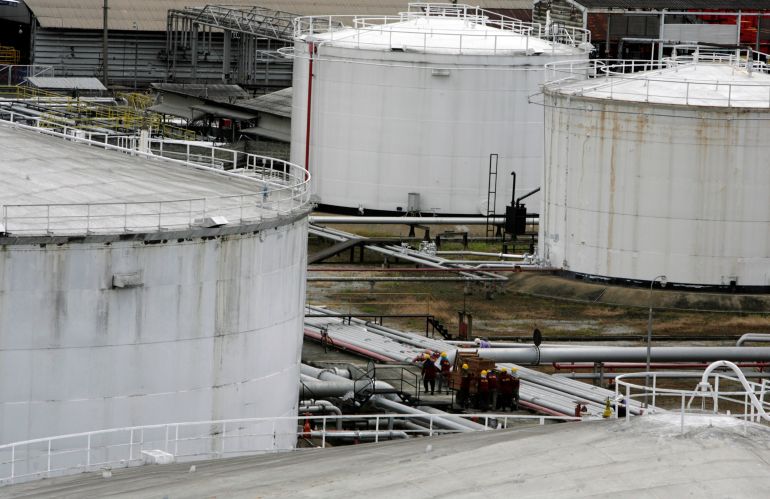
In Bangkok and Manila, the war has revived a push to establish comprehensive state-held strategic oil reserves.
Last month, a parliamentary panel in the Philippines approved a bill to create a 60-day government-held reserve.
Thai officials are moving forward with plans for new “cross-peninsula crude pipelines and tank farms, positioning Thailand against Singapore for Gulf crude storage”, said Ben Kiatkwankul at Maverick Consulting Group, a Bangkok-based public affairs consultancy.
In South Asia, the war has also pushed India to rethink its strategic stockpile.
India had about 74 days’ worth of oil stocks as of May, more than 90 percent of which was held by state-owned enterprises, according to S&P Global.
In July, India’s state-owned Oil and Natural Gas Corporation announced that it would build a reserve of 1.75 million metric tonnes, or 13 million barrels, in the country’s south, adding to the company’s plans to expand existing stockpiles by 6.5 million metric tonnes.
Asia’s biggest economies, meanwhile, have been exploring storage deals directly with Gulf suppliers.
“Japan, South Korea, and Singapore have longstanding relationships and partnerships with a number of Middle Eastern countries to locate storage supplies closer to their shores,” said Clara Gillispie, a senior fellow for climate and energy at the Council on Foreign Relations.
“For each of those three, we’ve heard some interest in expanding the existing capacity, as well as potentially signing new understandings,” Gillispie said.
“There’s also been conversations touching upon expanded relationships with India.”
The United Arab Emirates and its Abu Dhabi National Oil Company (ADNOC) already store oil in Singapore, India, South Korea, and Japan, while Kuwait and Saudi Arabia also have stockpiles in South Korea and Japan, according to the Observer Research Foundation, a public policy think tank based in New Delhi.
ADNOC is aiming to raise its crude oil storage capacity in India to 30 million barrels, while New Delhi is considering a proposal to store some of its strategic reserves at the UAE port of Fujairah on the Gulf of Oman, beyond the Strait of Hormuz bottleneck.
South Korean media have reported that Seoul is mulling whether to expand its oil reserves of some 146 million barrels by an additional 30-40 million barrels, up from initial plans for an extra 20 million barrels.

In China, the world’s second-biggest consumer of oil after the United States, the blockage of the Strait of Hormuz has reinforced a belief that the country must invest in its energy security, said David Fishman, a Chinese energy policy expert at the Hong Kong-based Lantau Group.
Beijing’s latest five-year plan (FYP) for oil and gas development, which sets policy for 2026 to 2030, included provisions for more pipelines and expanded LNG storage, among other measures such as expanded deep-water drilling.
State-owned pipeline operator PipeChina said in May that it was accelerating construction on some of its nearly 40 oil and gas projects, including 9,000 kilometres (5,590 miles) of domestic pipeline.
While these plans were drafted before the Iran war began, Fishman said the conflict has reinforced the rationale for such investments.
“So, while Hormuz couldn’t have been the direct driver of this language appearing in the 15th FYP drafts, it certainly underlines for policymakers that this line of thinking is clearly correct, and their assumptions about chronic instability are well-founded,” Fishman said.
“Whatever internal uncertainty there might have been around the costs or effort associated with building up potentially superfluous national energy reserves will certainly have evaporated,” he said.
Oxford’s Bakshi said the common thread across the region is reducing exposure to a “single fuel, supplier or chokepoint”.
“It is no longer enough to ask where the next barrel comes from,” Bakshi said.
“We also have to ask how it gets there, how long we can operate without it, and whether we can reduce our need for that barrel altogether.”