
Netflix hit us with Season 1 of Nightmares of Nature in Summer 2025, and Season 2 quickly followed. The three-episode docuseries, exec produced by horror-meister Jason Blum and featuring narration by Maya Hawke, takes an imaginative run at the nature doc form, combining the usual up-close photography of the animal kingdom with horror genre cues and a storyline of sorts, which pits its furry or scaly or many-limbed “heroes” against the sharp teeth, hunting prowess, and always lurking threats referenced by its title. Can real-life animals in their natural habitat also be the stars of something scary? Blumhouse thinks so.
Opening Shot: The disclaimer that opens Nightmares of Nature leaves a LOT of wiggle room. We’ll give it to you verbatim. “For the safety of our heroes and monsters, some scenes have been dramatized. All animal behaviors are natural.”
The Gist: And with that, we descend into what Maya Hawke’s narration describes generally as “the Central American jungle.” Nightmares of Nature forgoes onscreen titles, place names, or listed facts. Instead, Hawke establishes a tone somewhere between conversational and reading a storybook out loud to the class as she introduces the first “hero” of the series, a little white opossum. In time, we’ll catch him on a nest cam, cozied with his family, and see that same family confronted by danger. But for now, the opossum is darting around on some decidedly non-natural surfaces: the busted interior of an abandoned building. Nightmares calls it a laboratory that was closed for conducting illegal animal experiments, which just feels like creative backstory. The building we see looks like a mixture of artificial setup and CGI. But we’ll go with it, because this series is at least quite enamored with its “dramatized” situations.
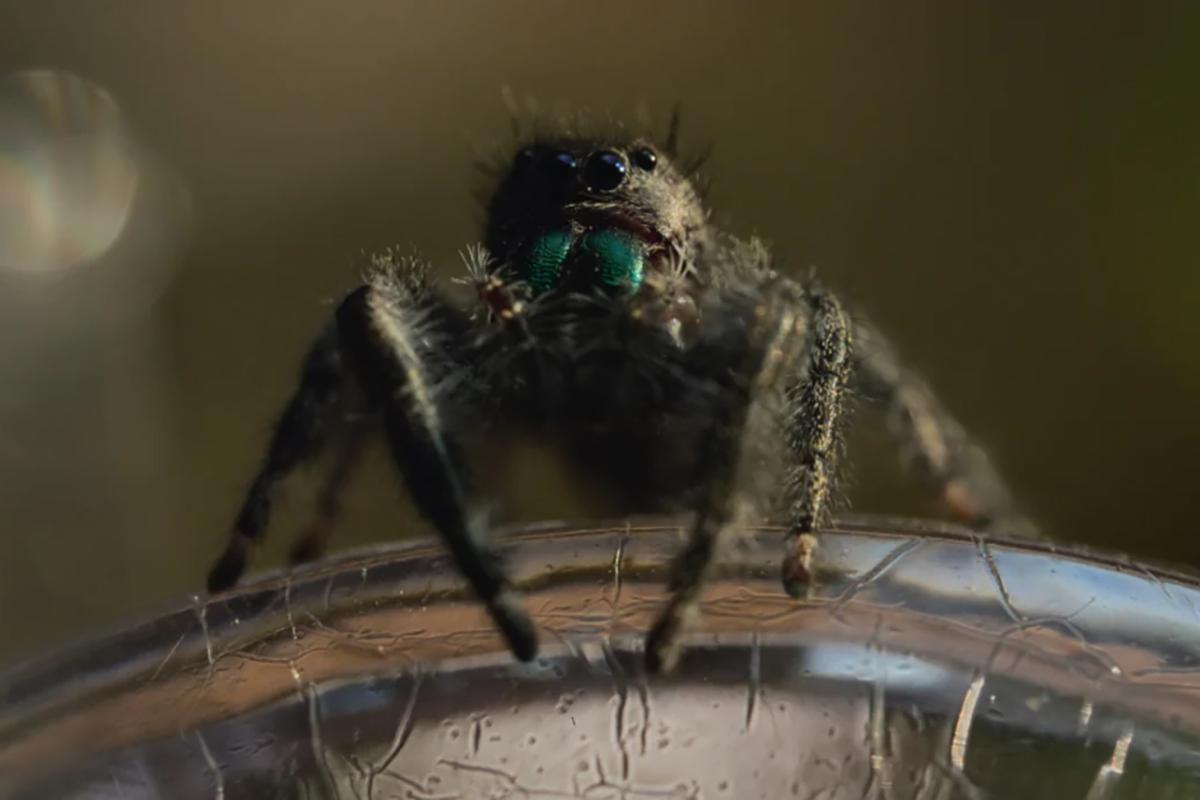
Is the opossum gonna get eaten? Threats abound, and he keeps getting separated from his furry fam. (Hawke: “What did I say about staying with the group?”) We also meet a baby iguana, its eyes blinking and skin a radiant green-blue as it pops out of the sand beside an unnamed jungle river, and later, a tiny jumping spider, with plenty of fascinating four-eyed close-ups. Where Nightmares is real and where it is manipulated often is not made clear. But its camera work revels in nature doc classicism, too, revealing its handful of heroes with lots of admiring beauty shots.
Nature is full of wonder and beauty, Hawke tells us. “But it’s also full of monsters.” And to that end, we get a sense of the predation faced by our little animal band. Howler monkeys. Harpy eagles. Crocs and caimans stalking ripples in the water. A black vulture poking his beak inside iguana eggs. A terrifying wasp attack on the jumping spider’s mate. When an ocelot picks up the opossum’s scent and location, the foot-long jungle cat pads after the guy with the certainty that dinner has arrived. But the rusted chainlink fence surrounding what’s left of the lab forms a barrier that wildcat can’t cross. The possum’s safe inside the lab’s crumbling walls! Or is he? Because as the jungle reclaims the building’s spaces, more hungry residents have moved in. Watch out, l’il buddy!
What Shows Will It Remind You Of? Nightmares of Nature producer-director Charlotte Lathane also worked on Welcome to Earth, a Disney+ docuseries that makes Will Smith’s hosting of the show immersive, similar to how Hawke’s narration in Nightmares has main character energy. And among Netflix’s other recent nature offerings is Predators, a deep dive into the natural world’s instinctual drive to survive.
Our Take: So we’re doing vibes-based nature documentaries now? To us, facts are the backbone of this format. Most nature docs will drop a few glistening morsels of science that you can use to impress your friends at parties. But Nightmares of Nature is different. From the horror movie font of its title card, to the choices Maya Hawke makes with her narration, to its unreliable mixture of real-life animal behavior and manipulated visuals, Nightmares is trying to make something that’s perhaps entertaining before it’s educational. It does drop its share of fast facts – iguanas stick together when they’re young; a jumping spider mom will not leave her web of babies, even to find sustenance for herself – but it’s more concerned with building an environment of its own design. A quadrant of jungle growth as haunted house. A tense battle in the water between predator and prey, with the suggestion of violence in a wisp of watery blood trail. Hawke chiming in with narration that might as well have an evil laugh attached. “An old abandoned building – how creepy. But the perfect setting for our scary story…”
We’re not trying to stand wholly behind nature doc dogma. The format has always contained variations, and in recent years, has been dominated by the David Attenborough Effect. There is room inside it to experiment, and Nightmares of Nature certainly is, booking a Stranger Things cast member to narrate and taking visual cues from the Blumhouse aesthetic. We feel like the relatively brief run-time of these episodes is also an advantage, because it contains and keeps focus on the storyline they’ve built, instead of the larger world its animal heroes are living in. We will miss the usual stream of facts. (We didn’t look up nearly as many animals while watching Nightmares as we normally do with nature docs.) But Hawke is game to interpret the material with style, and almost despite ourselves, we were hoping that little opossum found his way to safety, so the storytelling in Nightmares is workabl. You just gotta know going in that this will not be another riff on Planet Earth.
Sex and Skin: None.
Parting Shot: “His nightmare has only just begun…” As it drops a “To Be Continued” tease, Season 2 of Nightmares of Nature considers an obstacle from the ant’s eye perspective of one its animal world heroes. It’s another moment when this docuseries feels influenced by animated adventures. If the little rascal suddenly turned to the camera and said something like “Oh boy, I’ve got my work cut out for me,” as it closed the clasps on a tiny backpack full of supplies, we would not have been surprised.
Sleeper Star: “This shy nocturnal animal is only a threat…if you’re a banana.” A sleeper star of Nightmares of Nature Season 2 is the kinkajou, a frugivorous Weird Little Guy of the rainforests of Central and South America, whose memorable first-episode cameo accentuates Maya Hawke’s sometimes cheeky narration.
Most Pilot-y Line: The writing in Nightmares, with Hawke’s voiceover, aims for a stylized feel to match its visuals. “Everything is out to get you. Nowhere on Earth offers more creative ways to die. And as dusk arrives, a new cast of horrors begin to stir…”
Our Call: Stream It. Season 2 of Nightmares of Nature continues to interpret the nature doc form with a style sometimes closer to horror movies. How actually natural are the activities and outcomes it features? That can be an open question. But Nightmares and narrator Maya Hawke are invested in the style of the docuseries. And what’s more Spooky Season than being pursued by a predator through the dark underbelly of the natural world?
Johnny Loftus (@johnnyloftus.bsky.social) is a Chicago-based writer. A veteran of the alternative weekly trenches, his work has also appeared in Entertainment Weekly, Pitchfork, The All Music Guide, and The Village Voice.