
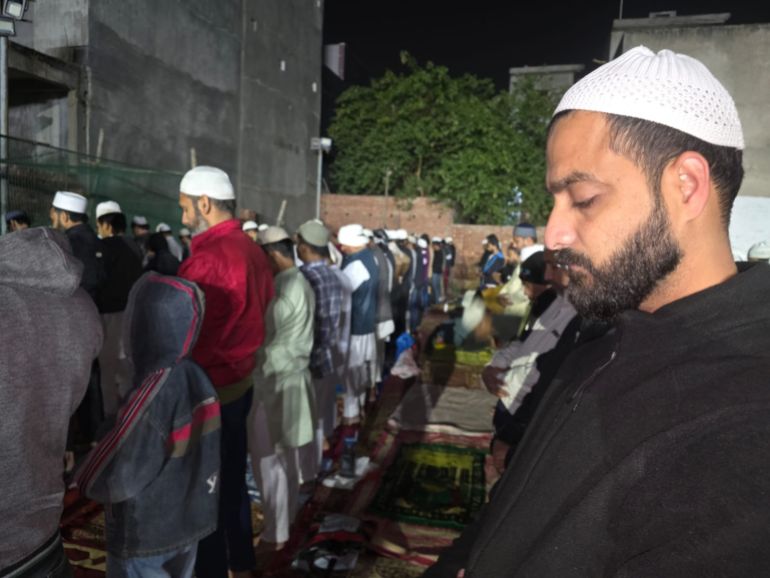
Meerut, India – The mood is barely festive as a group of Muslim men huddle inside a small mosque to discuss the arrangements for Eid al-Adha prayers in Meerut district of India’s Uttar Pradesh state.
Ceiling fans hum above to beat the brutal north Indian heat as nearly 50 worshippers listen to the members of the mosque management committee in Maliyana village, about 80km (50 miles) from New Delhi, the national capital.
Recommended Stories
list of 4 itemsend of list
The conversation is not about sacrificial animals or charity, but a more pressing issue before them: roads, barricades, police permissions, and where and how exactly they would offer the Eid prayers on Thursday.
“Please don’t gather outside the mosque gates,” instructs a member. “If the mosque fills up, wait for the next prayer shift. Avoid arguments. Avoid videos. Don’t respond to provocations.”
Men in the audience silently nod. Some scroll through WhatsApp groups where local police advisories have already begun circulating, urging Muslims to refrain from public prayers. Others in the audience exchange worried glances.
Maliyana has a history. In May 1987, 72 Muslims were massacred here by a mob of Hindu locals and personnel belonging to the state government’s Provincial Armed Constabulary (PAC). After 36 years of hearings, a district court in 2023 acquitted dozens of the accused over insufficient evidence.
But the concerns that prompted the mosque committee and worshippers there to review their Eid plans are more recent.
‘People are naturally scared’
For more than a decade now, right-wing Hindu groups, emboldened by the election of Hindu nationalist Narendra Modi as India’s prime minister in 2014, have been protesting against Muslims offering public prayers on Fridays and festivals against alleged traffic and security concerns.
These groups, and even politicians from Modi’s Bharatiya Janata Party (BJP), have disrupted namaz on roads, parks or vacant plots of land. Viral videos showing Muslims praying in open areas have sparked outrage and online campaigns, prompting the authorities, in some cases, to withdraw permissions granted to Muslims to offer namaz prayers at such sites.
Last week, the Vishwa Hindu Parishad (VHP), a prominent far-right Hindu group aligned with the BJP, demanded a complete nationwide ban on namaz on roads, calling the practice a “show of strength” by the community.
But Muslims argue that a crackdown on public prayers ignores a practical reality: many mosques and designated grounds for Eid prayers (called “Eidgahs”) cannot accommodate all the worshippers during mass congregations on Fridays or Eid, especially in densely populated urban areas.
A day before Eid al-Adha, the central question before Muslims is whether they will be allowed to pray peacefully, without attracting scrutiny, confrontation, or public hostility, particularly in BJP-governed Uttar Pradesh, a state almost as populous as neighbouring Pakistan and home to nearly 39 million Muslims, more than the population of Saudi Arabia.
The BJP government in Uttar Pradesh, led since 2017 by Yogi Adityanath, a saffron-clad hardline Hindu monk known for his vitriol against Muslims, has intensified crackdowns on Muslim prayers on roads and open spaces.
On May 18, Adityanath said Muslims should offer Eid al-Adha prayers “in shifts”.
“Pyaar se maanenge theek hai, nahi maanenge to doosra tareeqa apnayenge … (If they agree peacefully, that is good; if not, we will adopt another method),” he posted on X.
To the Muslims of Uttar Pradesh, the threat of Adityanath’s “another method” is not unfamiliar.
“Last year, people were booked for praying in open spaces. In some places, homes were demolished and there were even reports of driving licences and passport verifications being cancelled. After seeing all this, people are naturally scared,” a Muslim man in Meerut told Al Jazeera, requesting anonymity since he feared reprisal from the authorities.
Arif Malik, a shopkeeper in Aligarh district, about 130km (80 miles) from New Delhi, said that on Eid al-Adha last year, Muslims in his neighbourhood “offered namaz for barely a few minutes in an open ground, but police chased the worshippers afterwards”.
“This Eid, families are telling people to avoid any crowd,” he told Al Jazeera.
‘Earlier, Eid mornings felt joyful’
Muslims in Uttar Pradesh say the curbs on Eid prayers are creating an atmosphere in which even routine religious gatherings are increasingly treated as security concerns.
In several towns across the state, mosque committees are quietly recalibrating Eid arrangements. Some are reducing the size of congregations. Others are asking worshippers to arrive in smaller groups or disperse quickly after prayers. Community volunteers are being assigned to ensure people do not spill onto nearby roads, even briefly.
“For many Muslims, the concern is no longer only about where Eid prayers will be offered, but whether gathering publicly as a religious community is increasingly being viewed with suspicion,” said 42-year-old Mohammad Arif, a mosque committee member in Meerut who has been organising Eid prayers for nearly two decades.
Arif said the mosque committees in several Uttar Pradesh towns have held meetings about crowd management and ways to avoid confrontation with the authorities.
“People are thinking carefully about visibility, movement and even where to place their prayer mats,” he said.
“We are scared of even making a small mistake,” Arshad, a 33-year-old shopkeeper in Meerut who only shared his first name, told Al Jazeera.
“Earlier, Eid mornings felt joyful. Now there is tension from the night before. People keep checking whether police will come or whether someone will record videos and upload them online.”

For many Muslims, the psychological impact of such restrictions and targeting extends beyond the prayer ground.
“There is a fear of humiliation,” Numan Khan, a student at the Aligarh Muslim University, India’s largest minority academic institution, told Al Jazeera.
“Even if nothing happens physically, people are afraid of being filmed, targeted online, or accused of something. Parents tell young people to avoid standing outside mosques because they don’t want trouble.”
That fear has reshaped the community’s behaviour during the festivals in subtle but visible ways.
Mosque committees have begun coordinating directly with local police before Eid to avoid confrontation. Volunteers are being instructed to monitor entry points, prevent crowding, and quickly disperse worshippers after prayers end.
An imam in western Uttar Pradesh’s Saharanpur district described the preparations as “damage control”.
“We spend more time discussing restrictions than discussing Eid itself,” he said. “Avoiding controversy has become our priority.”
Another imam in state capital Lucknow said mass prayers traditionally overflow onto nearby streets for a short duration because of space shortages, not as an act of defiance.
“The prayer lasts a few minutes. Roads are reopened immediately afterward,” he told Al Jazeera. “This was never treated as a major issue before. Now it is presented as if Muslims are trying to occupy public spaces.”
The anxiety is not confined to Uttar Pradesh alone. Similar orders have been issued in other BJP-governed states, including West Bengal, and New Delhi, the national capital.
‘Nobody wants confrontation’
In the Muslim neighbourhoods of New Delhi, residents describe a growing sense of caution around visible religious celebrations.
Many Muslims interviewed for this story said they now think carefully about where they stand for the prayers, how long they remain outside mosques, and whether gatherings could trigger complaints or online outrage.
Outside New Delhi’s iconic Mughal-era Jama Masjid, traders gearing up for a brisk Eid business said discussions over prayer restrictions have become common in the area’s tea stalls and shops.
“Nobody wants confrontation,” Danish Khan, a 24-year-old garment seller, told Al Jazeera. “People simply want to pray and return home. But now every Eid comes with uncertainty about what new rules might appear.”
Despite the anxiety, preparations for Eid continue.
Markets remain crowded late into the night. Tailors rush to complete pending orders. Children tug at parents for new shoes and sweets. Inside mosques, volunteers clean carpets and arrange water for the hordes of worshippers expected on Eid morning.
But beneath the familiar rhythms of the festival lies an unmistakable unease.
And it is not just about Eid prayers. The ritualistic sacrifice of animals – goats, sheep or cattle – on Eid al-Adha is also being closely watched and heavily regulated, with threats of consequences if animal blood or waste enters public drains or streets.
All this is happening as references to Muslim religious practices dominate television debates and social media hate campaigns, when public demonstrations of Muslim identity are portrayed through the lens of security, legality, or demographic anxiety.
Several Muslims Al Jazeera talked to said a cumulative effect of repeated controversies — over the right to wear the hijab, eat halal food, make azaan calls on loudspeakers to name a few — has created a lingering sense of vulnerability within the community.
“You start feeling like everything connected to your identity is under question,” Faizan Ali, a software engineer in Noida, a dense suburb on the outskirts of New Delhi, told Al Jazeera. “Even praying becomes something you think twice about.”
Analysts say the controversy surrounding Muslim public prayers reflects a broader transformation in India, where Muslim visibility itself has become a contested terrain.
“When a community begins to fear assembling publicly for prayer during one of its most important religious occasions, it reflects a larger shift in how public space is negotiated and who feels entitled to occupy it,” Nadeem Khan, an activist and researcher on religion and public spaces, told Al Jazeera.
Selective enforcement of rules
While the government frames the restrictive measures around Muslim festivals as necessary for traffic management and public order, it has also not just allowed but also facilitated large Hindu religious processions and celebrations with traffic diversions, police protection, and public infrastructural support.
Critics, therefore, say the contrast with the crackdown on namaz deepens perception among Muslims of a selective enforcement of rules.
“What people notice is not only the restriction itself, but the unequal application of rules,” a New Delhi-based lawyer told Al Jazeera on condition of anonymity over fears of being targeted by the government.
“The constitution protects religious freedom, subject to public order. But if one community repeatedly experiences tighter scrutiny while others receive accommodation, it raises questions about equality before law,” he added.
The issue of public sites for Muslim prayers has become particularly sensitive because restrictions have increasingly been accompanied by punitive measures.
Over the past decade, authorities in several BJP-governed states have filed police cases against Muslims accused of offering prayers in open spaces without permission. In some instances, the officials have also carried out demolitions targeting homes or properties allegedly linked to the individuals accused of organising the public prayers.
Critics say such actions are excessive and discriminatory, and have transformed routine acts of worship into matters of criminal enforcement.
“Public space is not just physical space,” said Azhar Ahmad Khan, a New Delhi-based sociologist. “It is also symbolic. The debate over namaz is ultimately about who feels entitled to visibility, legitimacy, and belonging in contemporary India.”